


The cookbook shelf in your kitchen is a graveyard of restaurant relationships. You bought The French Laundry Cookbook because you once had the tasting menu and wanted to remember the night. You may or may not have made any of the recipes. You have flashy tomes from Estela, Wildair and Lil’ Deb’s Oasis all sitting next to it, unused. You bought the King tote because the logo looked good in that serif font. It is now holding onions in your pantry. The matchbook you pocketed at Carbone is in a junk drawer somewhere, and the Instagram post you tagged the restaurant in is buried three years deep in your grid. These are all, in their own way, souvenirs; small monuments to a memorable night living in the past.
Restaurants have been trying to extend their brand beyond the four walls of the dining room since the first chef signed a cookbook deal. But a cookbook is still a one-time transaction. A tote bag is a thing you buy once. What a handful of hospitality brands are now pursuing on Substack is something more exciting: not a souvenir of a meal you had, but an ongoing relationship that lives in your inbox every month.
The new move is not merch. It is media — publishing that not only promotes the restaurant, but becomes a second product the restaurant makes… a way to extend the hospitality philosophy into a different medium entirely.
In other words, the best hospitality brands are also now media brands.
We started Hospitality Everywhere for a version of the same reason. Crown Creative is a creative agency for hospitality, which means we spend our days thinking about what makes a place feel like itself. A hotel lobby can telegraph a brand. A wine label can. A website can. But those are all fixed. A Substack is more alive, more informal. It lets us talk about the work while the work is still in progress, in a voice looser and more intimate than a portfolio ever allows. We are making our own second product: an ongoing conversation about hospitality, published by the people designing it.
Smithereens publishes a full editorial zine with input from its whole staff. Stissing House in Pine Plains uses its monthly to build a world around an experiential calendar… aptly named Stissing World. Ryan Bartlow writes as a first-person narrator from deep inside the kitchen. These are not newsletters promoting a restaurant. They are the restaurant’s second product — delivered in a different medium, consumed on a different clock.
Let’s look at the leaders.
Smithereens (a New York Times three-star with roughly fifty seats in the East Village) has taken the movement to new heights with a full editorial zine.
Smithereens Zine has a named editor, Cordelia Calvert, who is a real lit-world professional. It has bylines from the whole staff, front and back of house; and it has recurring columns like beverage director Nikita Malhotra’s “No Spitting.” The issues are organized around a theme: “On the life changing power of lunch.” “On desserts & disco.” It reads like a print quarterly. It happens to be published by a restaurant.
But here is the part that breaks the old model: if you read Smithereens Zine every month and never book a table, the restaurant has still won. It is in your life. You have a relationship with a fifty-seat room you may never enter. The writing is not pointing at the restaurant. The writing is the restaurant, in a different medium.
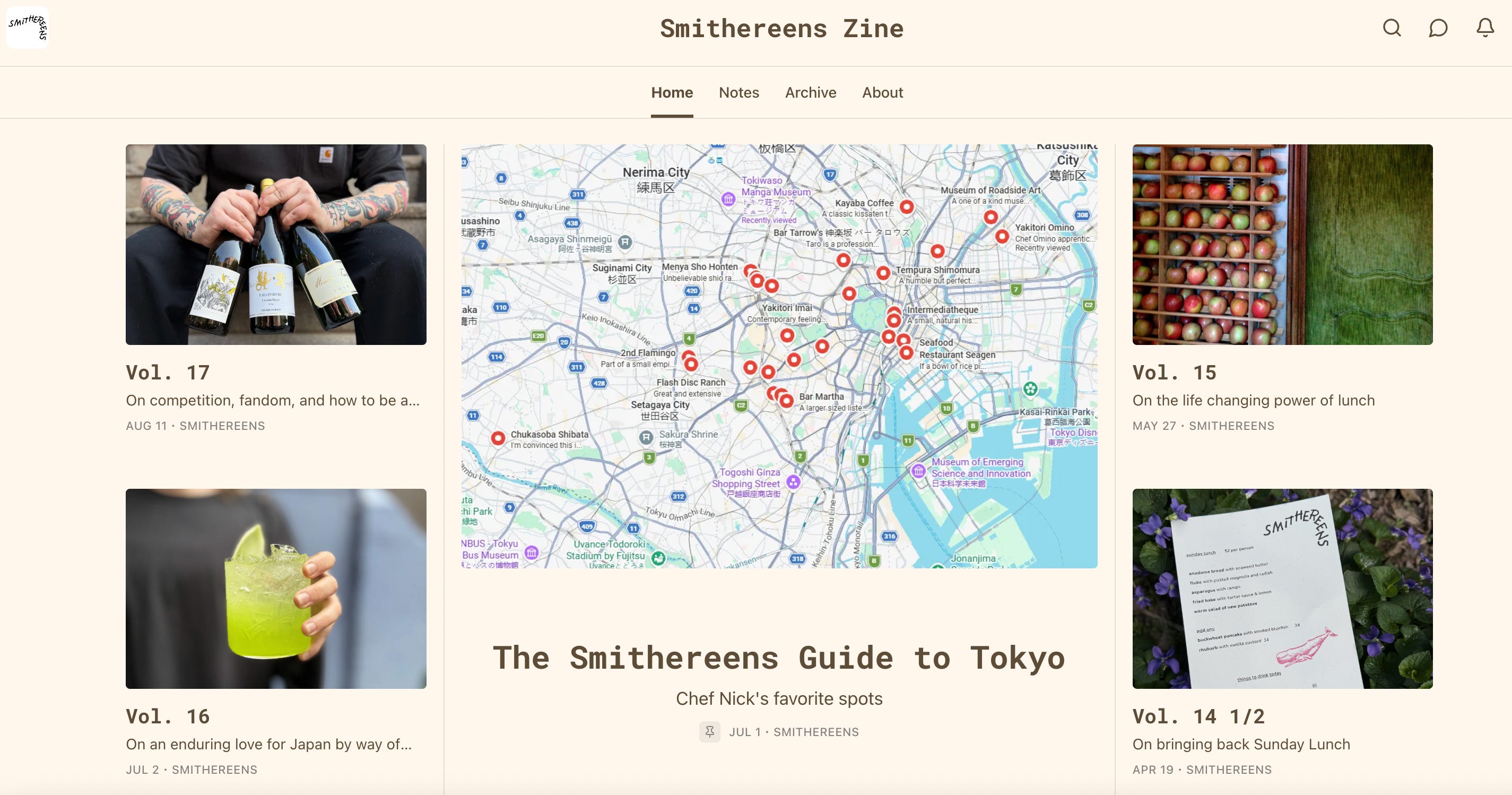
This is not better email marketing. It is a category switch. Traditional marketing communicates about the product. Smithereens Zine is a second product that happens to arrive in an inbox.
Stissing House is Clare de Boer‘s tavern in Pine Plains, housed in a building that dates to 1782. Its monthly dispatch, Stissing World, “shares our news and celebrates the Hudson Valley.” Each issue is wired to an event and to the community that gathers around it. The Sea Boil took place over the summer: enormous flame-licked cauldrons on the lawn, watermelon jelly for dessert. In April, a Shaker Supper turned the upstairs barn into a live scene from The Testament of Ann Lee, with guests invited to sit for a Q&A with the film’s choreographer after dinner.
Last November brought Pie Fest, an amateurs-only baking competition co-produced with Substack itself, and judged by, among others, Martha Stewart and Ignacio Mattos. (Worth noting that the winner of the Pie Fest was none other than Crown Creative’s very own lead strategist Nikki Freihofer). Substack produced a whole mini-movie of the event here.
The newsletter sells the event; the event gives the next issue something to write about. Along the way, Stissing World might interview the general manager, the beekeeper, or the florist responsible for the arrangements. It is email marketing recast as an aspirational community calendar and a love letter to the Hudson Valley countryside.


Ryan Bartlow, chef-owner of Ernesto’s and Bartolo, takes the opposite approach: the publication is the person. His own Substack moves between memoir, travel diary, and an unusually candid account of how his restaurants came together. In “Why I Opened Bartolo,” he frames the second restaurant as the difficult second album: Ernesto’s had absorbed everything he knew at the time, and Bartolo had to make a different argument. Then, writing as Caper’s Chef in Residence, he supplies the flip side. One dispatch begins with Bartlow elbow-deep in live abalone during a guest residency at Chez Noir in Carmel while, three thousand miles away, Bartolo’s air conditioning fails during a New York heat wave and increasingly miserable texts arrive from the staff. The chef steps out from behind the name on the menu and becomes a narrator — first-person, opinionated, and largely unvarnished.


None of this would be especially meaningful if Substack were still a niche platform, but it is not. The food leaderboard now includes Ottolenghi, José Andrés, Ruth Reichl, and Mark Bittman. The category has been legitimized, and the model has spread beyond restaurants. Ace Hotel’s Room with a View collects stories about the people who make places interesting, many of them emerging from its Artist in Residence program. But the deeper reason hospitality brands are writing is the same reason we are: Substack is email marketing with better manners — more social, more editorial, and built to carry a point of view rather than merely deliver an offer.
A restaurant used to have one product: the meal. Everything else (the PR, the email marketing, the physical merch) existed to sell that product. What Smithereens, Stissing House, and Bartlow are doing is splitting the restaurant into two products that run in parallel. One is edible and happens in a room at a specific time. The other is readable and happens in your inbox whenever you open it. You do not need to book a table to consume the second one. And that is the point.
Once you see it this way, the strategy questions change.
You stop asking “how do we get people in the door?” and start asking “what do we have to say this month?”
You stop thinking of the newsletter as a marketing channel and start thinking of it as a creative practice. The dining room becomes one expression of the brand. The newsletter becomes another. Different doors into the same worldview. None of them are just arrows anymore.
When a restaurant can hold your attention without ever feeding you, what business is it actually in?
Absolutely, spot on. I’ve been preaching Substack and the new anatomy of the newsletter to my community since 2024 — using my own evolution of wine bar owner, into now creative agency. It’s the next step in hospitality, that’s already happening.
Restaurant stories are ridiculous really. The staff member who has one weird regular, the supplier who has seen every disaster, the service that almost went completely sideways. That is the stuff people actually remember after the pasta is gone.